1 MIN READ
conference · 2025 · PublishedMammoBLIP
Can a mammogram be turned straight into a report?
IN ONE SENTENCE
Summary
Freeze a vision foundation model, freeze a biomedical LLM, train only the small bridge between them — and see how close the generated report gets to the reference.01 / THE QUESTION
A BI-RADS score is not a report.
Breast imaging models are built one task at a time — detect a mass, classify malignancy, estimate risk. A radiologist instead writes a paragraph that ties laterality, view, findings, BI-RADS category and a recommendation together.
Whether an image-to-text model can produce that paragraph for mammography had not been examined at scale.
02 / THE IDEA
Train the bridge, not the backbones.
A frozen EVA-CLIP Vision Transformer supplies patch features; a frozen BioMedLM writes the text. Between them sits a small trainable transformer that projects image and text into one 256-dimensional space, aligned with a symmetric contrastive loss.
The image embedding is inserted between the prompt and the target tokens, and the language loss is computed only over the report. Everything fits on one GPU.
- 01Mammogram
- 02Frozen EVA-CLIP
- 03Bridge transformer
- 04Shared 256-D space
- 05Frozen BioMedLM
- 06Structured report
03 / WHAT WE TESTED
One corpus out of five public repositories.
VinDr-Mammo, RSNA, CMMD, INbreast and KAU-BCMD were put through a single DICOM-to-PNG, cropping and normalization pipeline, and their structured labels were converted into consistent radiology-style reports.
Stratified sampling kept the clinical-attribute distributions comparable across splits.
04 / MAIN RESULT
Fluent and semantically close — and dataset-dependent.
Over all 13,242 test pairs the generated reports reached BLEU 65.36, ROUGE-1 0.75, BERT-F1 0.88 and SBERT similarity 0.91, at a reading level around grade seven.
The spread between sources is the more interesting number: standardized, homogeneous reporting (KAU) is far easier to reproduce than an older, more heterogeneous cohort (INbreast).
| Dataset | BLEU | ROUGE-1 | BERT-F1 | SBERT |
|---|---|---|---|---|
| KAU-BCMD (334) | 85.86 | 0.92 | 0.96 | 0.93 |
| VinDr-Mammo (4,000) | 75.45 | 0.84 | 0.92 | 0.92 |
| RSNA (8,285) | 60.66 | 0.71 | 0.86 | 0.91 |
| CMMD (560) | 56.12 | 0.71 | 0.86 | 0.90 |
| INbreast (63) | 53.01 | 0.70 | 0.86 | 0.93 |
| Overall (13,242) | 65.36 | 0.75 | 0.88 | 0.91 |
Values exactly as reported. No internal baseline or ablation was run, so these are absolute scores rather than a comparison.
05 / WHY IT MATTERS
Text output is checkable output.
A generated report can be read and corrected line by line, which a single probability cannot. That makes it a more useful object for clinical scrutiny — and a better starting point for grounding and explainability work.
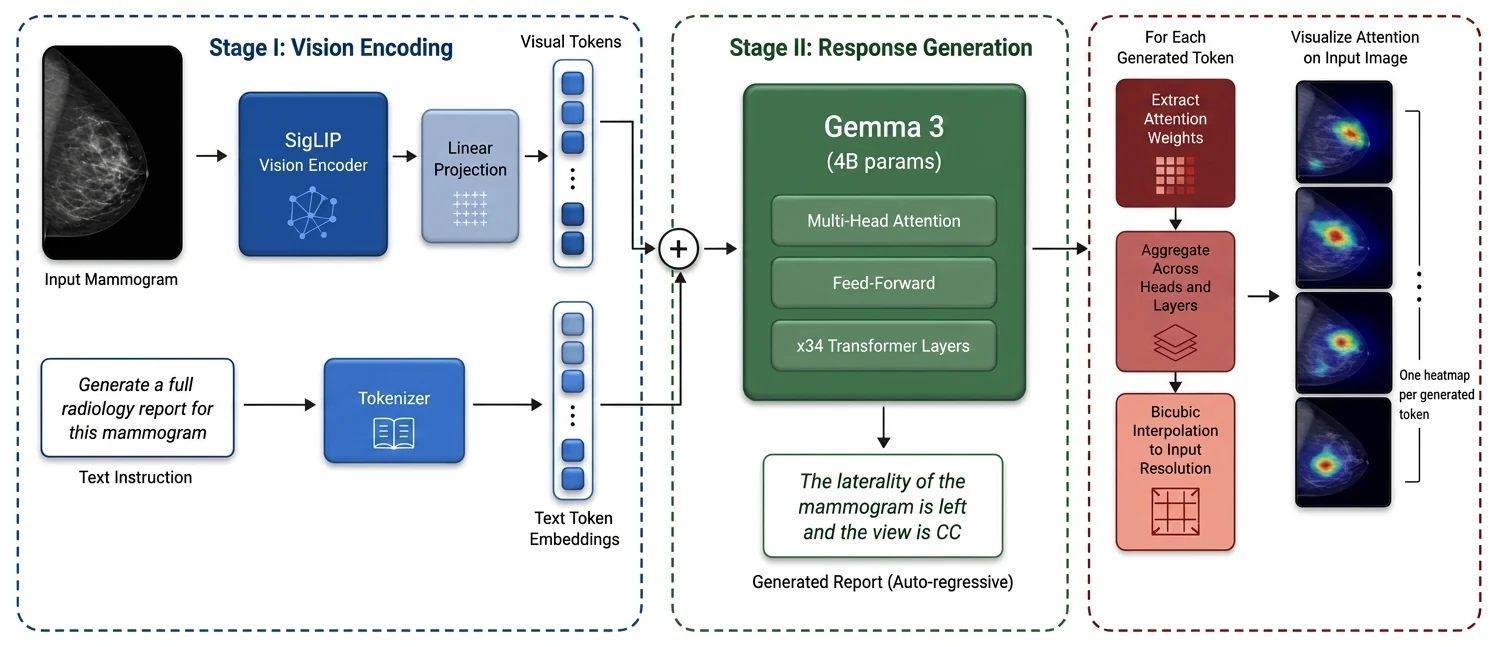
This model became the baseline for the follow-up work on token-level attention grounding.
LIMITATION
What this does not show
There is no baseline model, no ablation and no reader study, and the references are reports derived from dataset labels rather than free-text clinical dictation. High overlap scores therefore say the model learned the label-to-report mapping well, not that it is clinically reliable.
READ IT YOURSELF
Paper · DOI · Code · Citation
View original abstract + citation
Abstract
Breast imaging AI is largely task-specific: lesion detection, risk stratification or malignancy classification, each in isolation. None of these produce the structured, comprehensive report a radiologist writes. MammoBLIP is an end-to-end vision-language framework that generates mammography reports directly from an image. A frozen EVA-CLIP Vision Transformer supplies patch features, a lightweight MedBLIP-style transformer projects image and text into a shared 256-dimensional space with a symmetric contrastive loss, and a frozen BioMedLM decoder generates the report autoregressively. The model is trained on 81,076 mammograms curated from five public repositories with a unified preprocessing and label-to-report pipeline, and evaluated on 13,242 held-out report pairs.
Citation
A. Bhandary Panambur, S. Wind, S. Bayer, A. Maier. MammoBLIP: End-to-End Mammography Report Generation with Vision-Language Models and Public Multi-Institutional Datasets. 2025 IEEE NSS/MIC/RTSD, Yokohama, Japan, 2025. doi:10.1109/NSS/MIC/RTSD57106.2025.11286311