SELF-SUPERVISED LEARNING
Representation learning, DINO-style pretraining, transfer learning, foundation-model research.
No results found.
Answers built from this site
NHR@FAU · Erlangen National High Performance Computing Center
Pattern Recognition Lab, FAU Erlangen-Nürnberg
Research Scientist · Medical AI · Multimodal AI · AI Systems
I work across representation learning, multimodal and foundation models, LLM and VLM applications, and scalable GPU inference — and on getting those methods close enough to clinical imaging data to be tested properly.
Erlangen, Germany
SELF-SUPERVISED LEARNING
Representation learning, DINO-style pretraining, transfer learning, foundation-model research.
VISION-LANGUAGE MODELS
Medical image-text learning, CLIP-style models, multimodal reasoning, report generation.
LARGE LANGUAGE MODELS
Local LLMs, foundation-model APIs, RAG, LLM evaluation, applied GenAI systems.
MULTIMODAL MEDICAL AI
Mammography, breast MRI, detection, localization, explainability, clinical validation.
AI SYSTEMS + HPC
GPU inference, model serving, distributed and HPC workflows, research software.
01 / AI SYSTEMS
I build the layer between a model and something people can actually use: local LLM and VLM runtimes, embeddings and retrieval, RAG, agent workflows, foundation-model APIs, and GPU inference on HPC infrastructure.
Architecture and capabilities only — project and partner details stay confidential.
WHAT I AM WORKING ON NOW
Deploying and evaluating LLM and VLM runtimes for privacy-aware, GPU-backed research applications.
Prototyping retrieval pipelines that connect domain knowledge with foundation-model APIs and locally deployed models.
Building tool-using agent workflows, model-backed interfaces, and reproducible research software around open-source AI frameworks.
Designing training, serving, and inference workflows for GPU clusters and supercomputing environments.
02 / THE THREAD
One line runs through everything I have worked on: keep the information that matters in a difficult image, learn a representation from it, connect that representation to language and reasoning, then make it run and hold up on someone else's data.
High-resolution mammography, breast MRI, CT and cell imaging — curated and standardized.
Self-supervised pretraining on the target cohort rather than on ImageNet alone.
Aligning image regions with radiology language so models can be described, not just scored.
Structured findings, BI-RADS categories, generated reports and grounded evidence.
Distributed training, GPU inference and serving that make the above reproducible.
Retrospective evaluation with radiologists on real, external cohorts.
03 / FEATURED RESEARCH
Learning representations without labels, generating language from images, supervising a 3D model from one annotated slice, and letting a dataset shape its own training objective.
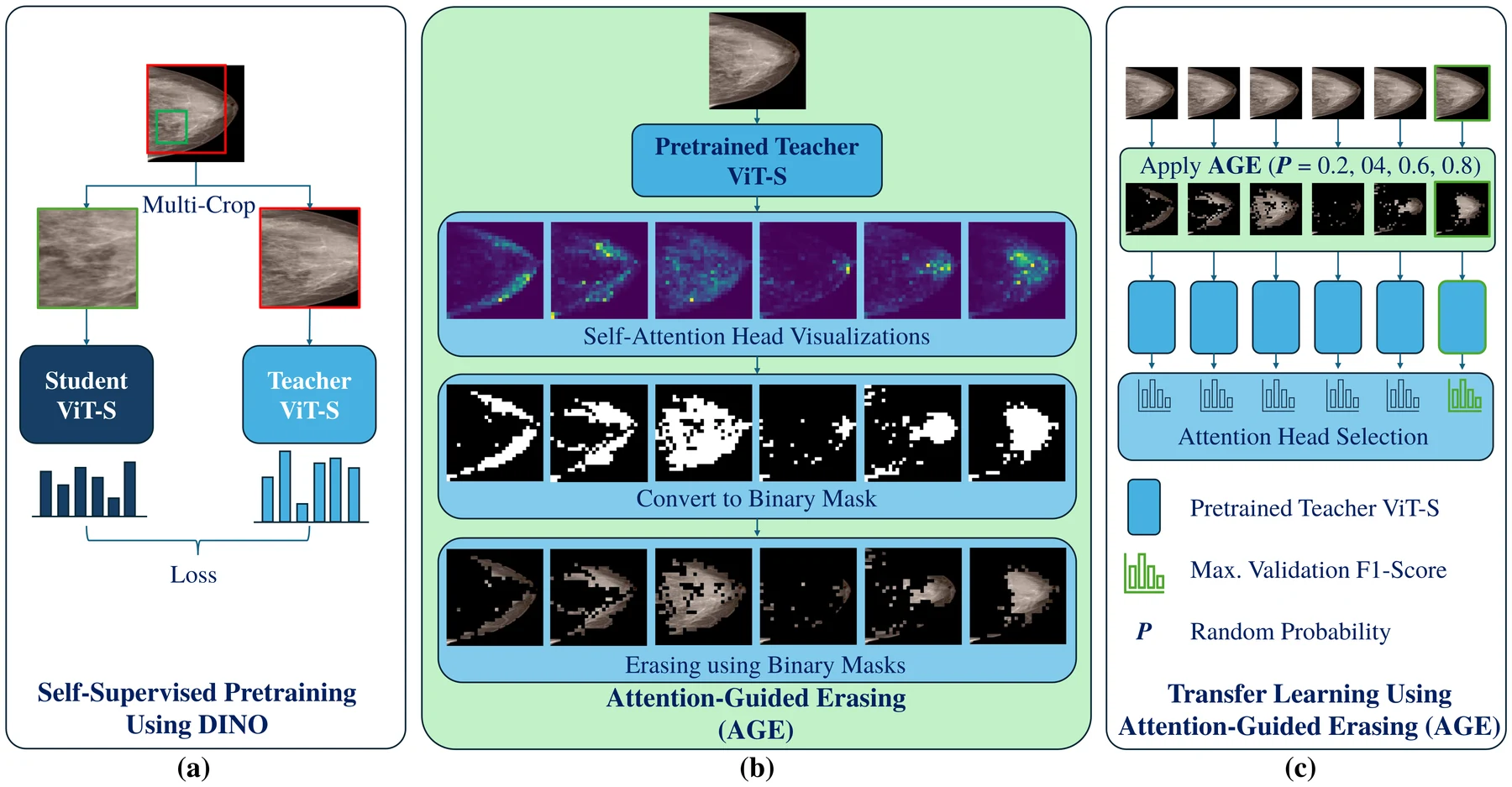
01 / SELF-SUPERVISED REPRESENTATION LEARNING
Use a self-supervised model's own attention to choose which pixels an augmentation is allowed to destroy — then check the four tasks where that helps and the one where it does not.
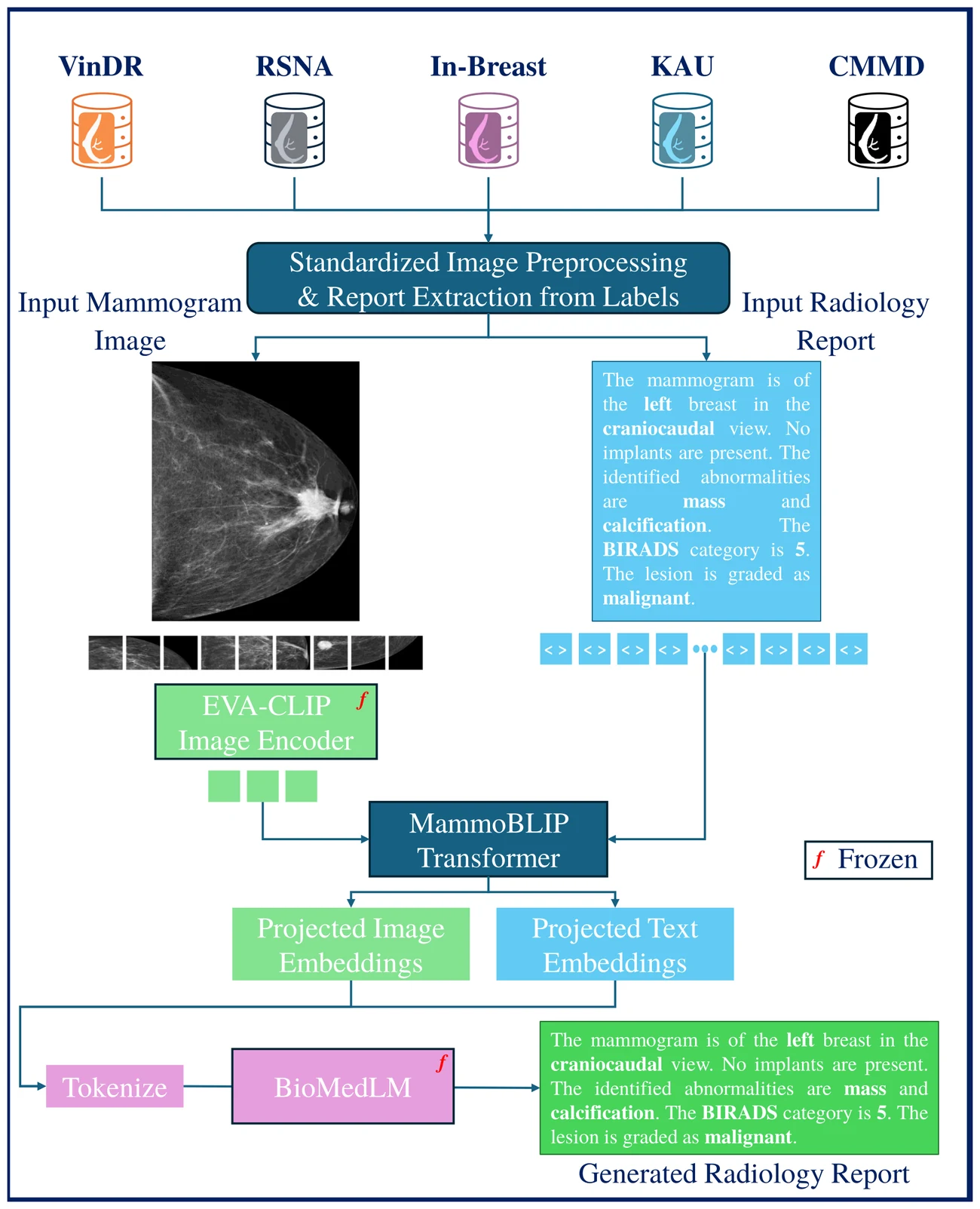
02 / VISION-LANGUAGE MODELS
Freeze a vision foundation model, freeze a biomedical LLM, train only the small bridge between them — and see how close the generated report gets to the reference.
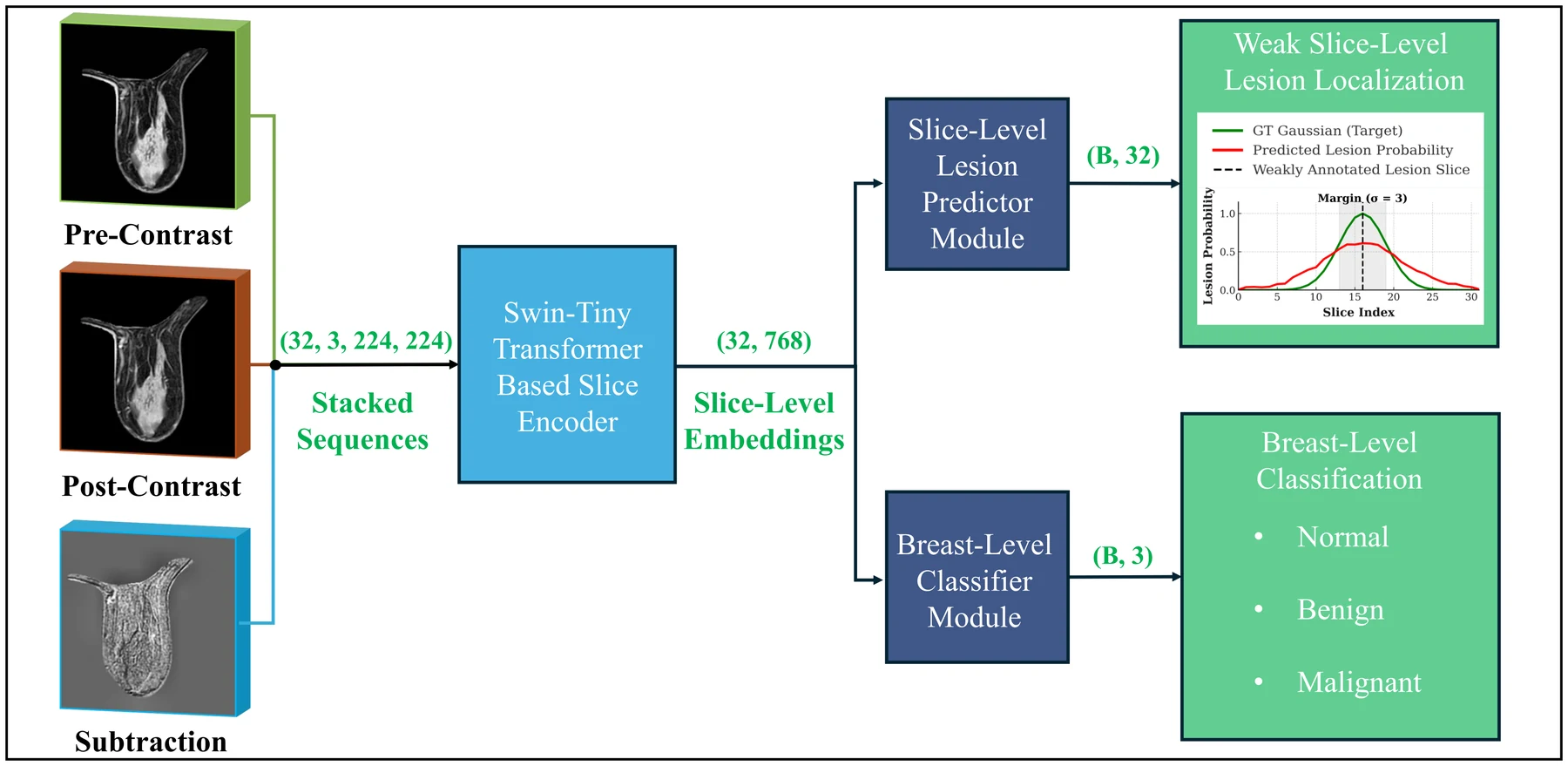
03 / WEAK SUPERVISION + EXPLAINABILITY
Give a volumetric breast MRI model exactly one radiologist-marked slice per exam, shape it into a Gaussian target, and ask whether both the diagnosis and the localization improve.
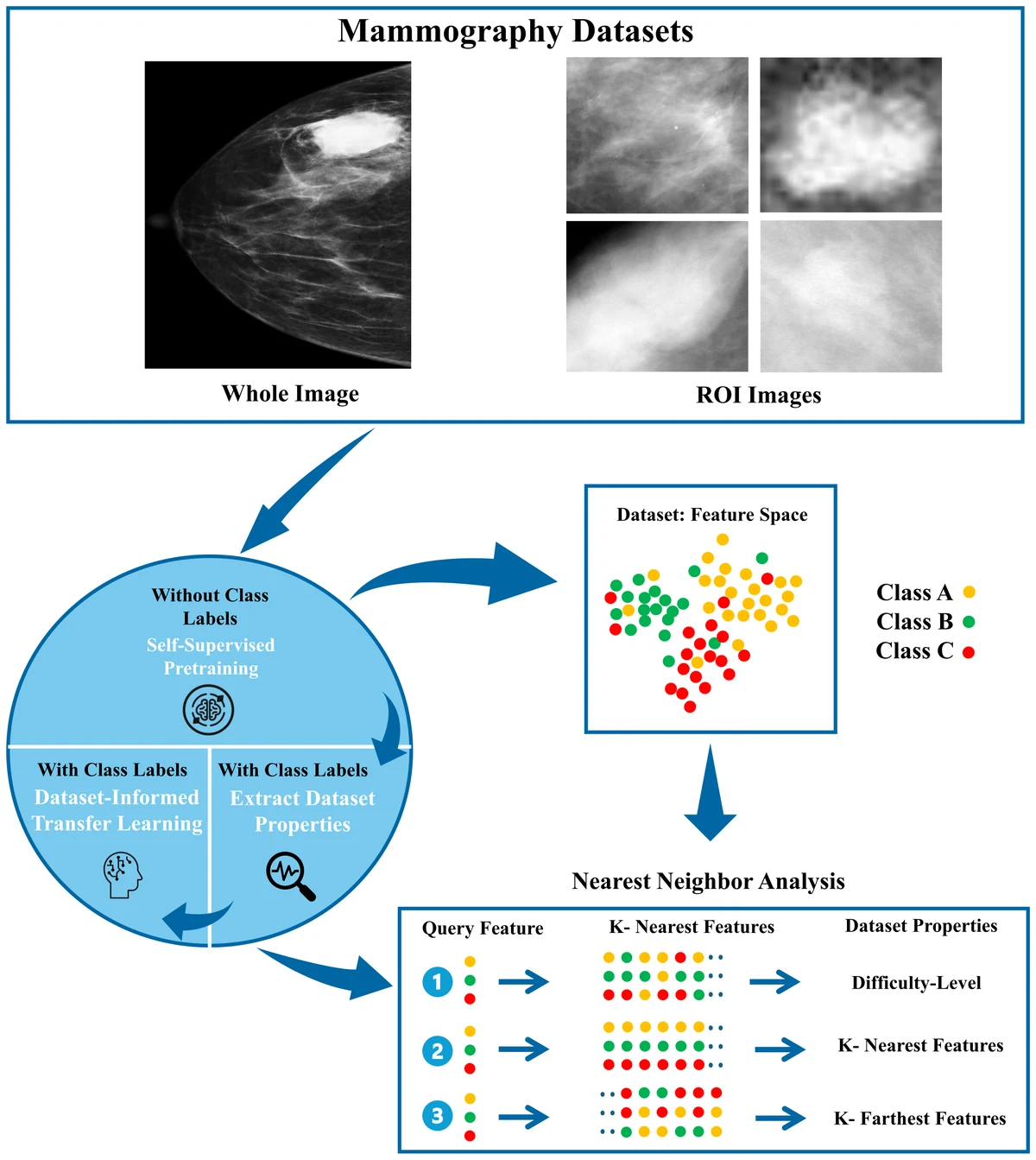
04 / ADAPTIVE TRAINING OBJECTIVES
Take the three quantities I previously hand-tuned — sample difficulty, triplet margin, neighbour count — and derive all of them from the data's own self-supervised feature space instead.
04 / TRAJECTORY
Each step here was driven by a limitation in the previous one. The order matters more than the count of papers.
2019 — 2022
CNN classifiers for calcification patches and unstained blood cells, with augmentation studies rather than architecture chasing.
BVM 2022 · IJLH 2023
2022 — 2023
Reusing abnormality classifiers as initialization for harder targets, including luminal subtype prediction from whole mammograms.
arXiv:2301.09282
2023 — 2025
DINO pretraining on the target cohort, then using its attention as a task-aware augmentation policy instead of a segmentation label.
BVM 2024 · IJCARS 2025
2024 — 2025
Contrast-enhanced mammography, neighbourhood-informed losses, and multi-view multi-modal detection that mirrors how radiologists read.
SPIE MI 2024 · Deep-Breath MICCAI 2025
2025
End-to-end mammography report generation from a frozen vision encoder and a frozen biomedical LLM joined by a small trained bridge.
IEEE NSS/MIC/RTSD 2025
2025 — 2026
Objectives that adapt to a dataset's own structure, and lesion-aware contrastive pretraining across multiple public cohorts.
arXiv:2607.26043 · ECR 2026
2026
Domain-adapted SigLIP encoders with 4B-parameter LLMs for grounded report generation; retrieval, agents and local models in applied work.
NHR@FAU · manuscript in preparation
2026 — present
GPU inference, model serving, and reproducible distributed workflows so the research above runs at cluster scale.
NHR@FAU
05 / SKILLS
Grouped by what they are for, not sorted by how impressive they sound.
06 / EXPERIENCE
Medical devices, then clinical AI inside a manufacturer, then a hospital cohort, then a supercomputing centre. Each move added a constraint the previous one did not have.
Full CVAI systems + applied GenAI
June 2026 — Present
Erlangen, Germany
NHR@FAU · Erlangen National High Performance Computing Center
Medical AI research
May 2020 — Present
Erlangen, Germany
Pattern Recognition Lab, FAU Erlangen-Nürnberg
Clinical validation
July 2024 — September 2024
Chengdu, China
West China Hospital, Sichuan University
Mammography AI
May 2020 — February 2024
Erlangen, Germany
Siemens Healthineers
Deep learning
October 2017 — March 2020
Erlangen, Germany
Siemens Healthineers
Medical devices
March 2015 — February 2016
Bangalore, India
Transcaal Engineers India Pvt. Ltd.
Medical devices
September 2014 — February 2015
Bangalore, India
Transcaal Engineers India Pvt. Ltd.
EDUCATION
Friedrich-Alexander-Universität Erlangen-Nürnberg
May 2020 - PresentFriedrich-Alexander-Universität Erlangen-Nürnberg
April 2016 - March 2020Dr. Ambedkar Institute of Technology, Bangalore
August 2010 - June 201407 / SELECTED PAPERS
23 entries across mammography, breast MRI, representation learning and vision-language models — each with its DOI or preprint link.
Full archiveBildverarbeitung für die Medizin (BVM) 2026, 10–17 · Published
0.8683Test AUC
Manuscript in preparation — no venue yet · 2026 · not peer reviewed
0.877ROUGE-1
arXiv preprint (accepted at the International Conference on Computer Vision and Image Processing, CVIP 2025 — in print) · 2026 · CVIP 2025 in print · not peer reviewed
0.609VinDr density macro F1
International Journal of Computer Assisted Radiology and Surgery, 20(3), 433–440 · 2025 · Published · open access (CC BY 4.0)
4 / 5Significant gains
2025 IEEE Nuclear Science Symposium, Medical Imaging Conference and Room Temperature Semiconductor Detector Conference (NSS/MIC/RTSD), Yokohama · Published
65.36BLEU overall
08 / TALKS
Oral presentations at BVM, SPIE Medical Imaging, IEEE MIC, CVIP and the Pattern Recognition Symposium.
All talksScroll sideways for all 5 — click any photo to enlarge.
09 / CONTACT
I am interested in research collaborations and roles across multimodal AI, vision-language models, applied GenAI systems and medical imaging. Email is the fastest way to reach me.