1 MIN READ
preprint · 2026 · Preprint · in reviewBE-WISER
What if only half the exams can be annotated?
Not peer reviewed — treat the numbers below as preliminary.
IN ONE SENTENCE
Summary
Give the slice-level head a class instead of a yes/no, then test what happens when a radiologist marks only half the cohort and a first-stage model guesses the rest.01 / THE QUESTION
Binary slice supervision throws information away.
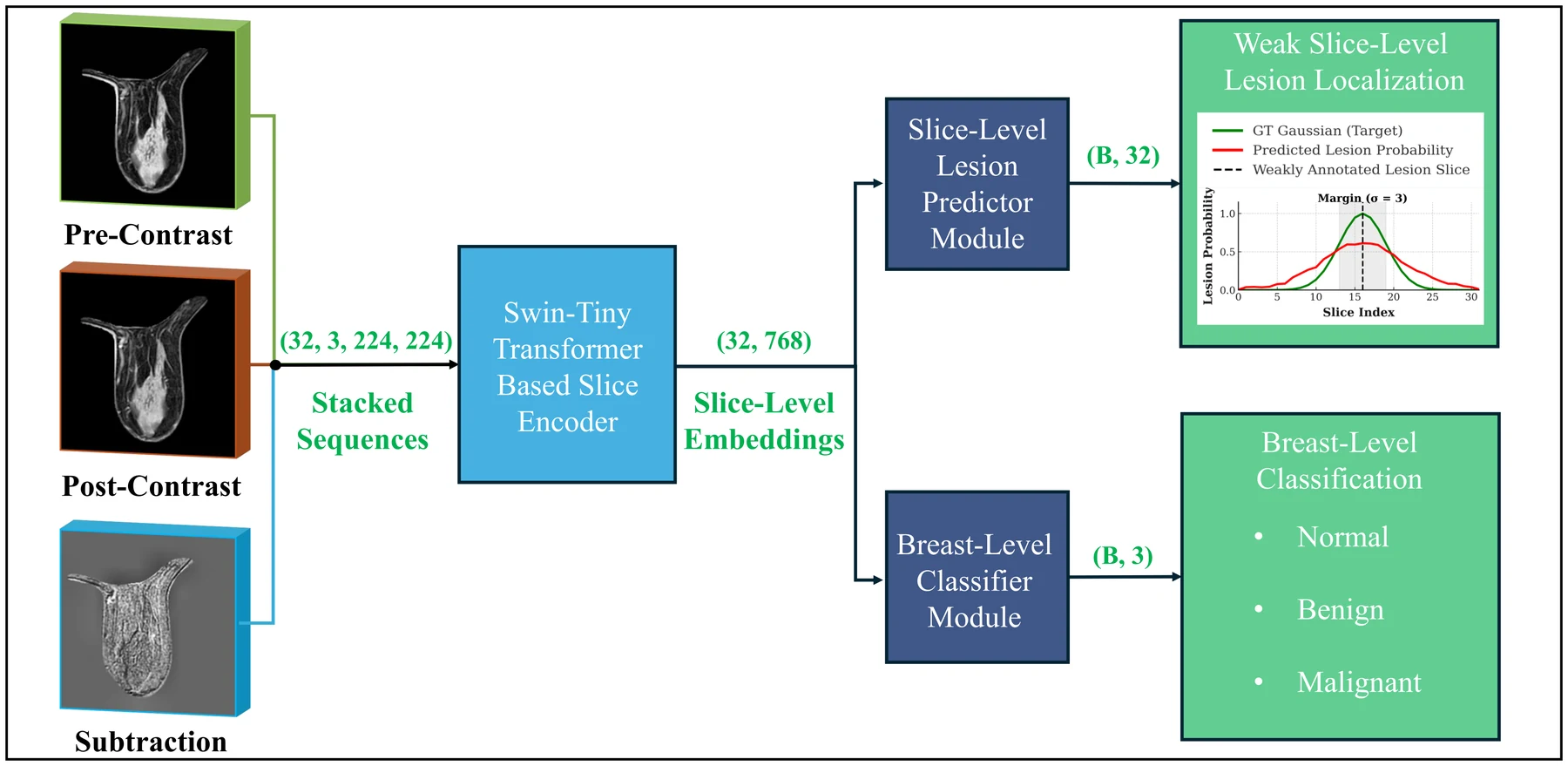
BE-WISE trained its slice head to answer one question: is there a lesion on this slice? But the exam-level label already says whether that lesion is benign or malignant, and that information was going unused at slice level.
The second question was harder and more practical: how much does performance drop if only half the exams get a radiologist-marked slice?
02 / THE IDEA
Give every slice a class, not a flag.
Slices inside the Gaussian region around the marked slice inherit the exam's class; the remainder are labelled normal, and normal exams are normal throughout. The slice head becomes a three-way softmax, weighted by (1 + t) so slices nearer the marked one count more.
For the reduced-label setting, a first-stage model trained on the annotated half predicts pseudo weak slice targets for the unannotated half.
- 0136 slices × 3 sequences
- 02SwinV2-Tiny encoder
- 03ABMIL breast branch
- 043-class slice head
- 05Gaussian-weighted loss
- 06Diagnosis + slice evidence
03 / WHAT WE TESTED
A larger, more heterogeneous ODELIA release.
926 training, 230 validation and 292 test examinations from six institutions — a bigger and more institutionally diverse cohort than BE-WISE used. The test set was evaluated exactly once, from the checkpoint with the best validation AUC.
Baselines: a Medical Slice Transformer, a breast-level-only classifier sharing the same encoder, and BE-WISE itself, each with cross-entropy and with focal loss, over five seeds.
04 / MAIN RESULT
Better diagnosis, better localization, and a usable annotation budget.
With focal loss, BE-WISER reaches AUC 0.864 and ODELIA score 0.699 — 10.8 points of ODELIA score above the breast-level baseline and 2.6 above BE-WISE. Localization improves in the same direction: Hit@1 0.554 → 0.632.
The reduced-label result is the one worth quoting to a clinical partner. Annotating half the cohort and pseudo-labelling the rest gets to 0.654, most of the way to the fully annotated 0.699.
| Model | AUC (CE) | ODELIA (CE) | AUC (focal) | ODELIA (focal) |
|---|---|---|---|---|
| Medical Slice Transformer | 0.746 (0.038) | 0.503 (0.031) | 0.753 (0.032) | 0.523 (0.063) |
| Breast-level baseline | 0.796 (0.076) | 0.578 (0.117) | 0.807 (0.037) | 0.591 (0.069) |
| BE-WISE | 0.849 (0.010) | 0.669 (0.016) | 0.852 (0.006) | 0.673 (0.005) |
| BE-WISER | 0.856 (0.017) | 0.692 (0.043) | 0.864 (0.004) | 0.699 (0.027) |
ODELIA score = mean of AUC, sensitivity at 90% specificity and specificity at 90% sensitivity. Paired testing: p < 0.0001 for BE-WISER over the baselines.
05 / WHAT THE MODEL SHOWS
The predicted peak lands on the radiologist's slice.
For correctly localized cases the predicted positive-class probability rises exactly where the Gaussian target sits. Averaged over the test set the BE-WISER profiles are smoother and more lesion-centred than BE-WISE's, with fewer off-target spikes on malignant cases.
Even for exams the model classifies as normal by mistake, the slice probability often still peaks near the annotated lesion slice — which is precisely the case where a reviewer would want to look.
06 / WHY IT MATTERS
It prices the annotation.
Most weak-supervision papers show that weak labels work. This one quantifies what halving the annotation budget costs, which is the number that decides whether a multicentre study happens.
The slice-level output stays what it was designed to be: decision-support evidence for a radiologist to check, not an autonomous read.
LIMITATION
What this does not show
Still a preprint, still one slice per exam, and pseudo weak annotations inherit the first-stage model's mistakes. External validation and reader studies have not been done.
READ IT YOURSELF
Paper · DOI · Code · Citation
View original abstract + citation
Abstract
BE-WISE showed that a single radiologist-marked slice per breast MRI examination can supervise both diagnosis and coarse lesion localization, but its slice-level head was binary: lesion or no lesion. BE-WISER extends that supervision to class-aware slice semantics, so each slice inside the weak lesion region inherits the breast-level class (benign or malignant) and everything else is labelled normal. A shared SwinV2-Tiny slice encoder feeds an attention-based multiple-instance-learning branch for the breast-level decision and a three-class slice head trained with Gaussian-weighted cross-entropy. On the latest multicenter ODELIA release the framework improves both classification and localization over BE-WISE, and a two-stage pseudo-annotation protocol recovers most of the performance when only half the exams have a radiologist-marked slice.
Citation
A. Bhandary Panambur, T.-T. Nguyen, S. Islam, M. Uder, S. Bickelhaupt, A. Maier, S. Bayer. BE-WISER: Class-Aware Weak Slice-Level Supervision for Breast MRI. Research Square preprint, 2026. doi:10.21203/rs.3.rs-9855612/v1