AUCReshaping: Improved Sensitivity at High-Specificity
Scientific Reports / 2023 / journal
Bhat S, Mansoor A, Georgescu B, Panambur AB, et al.
Scientific summary
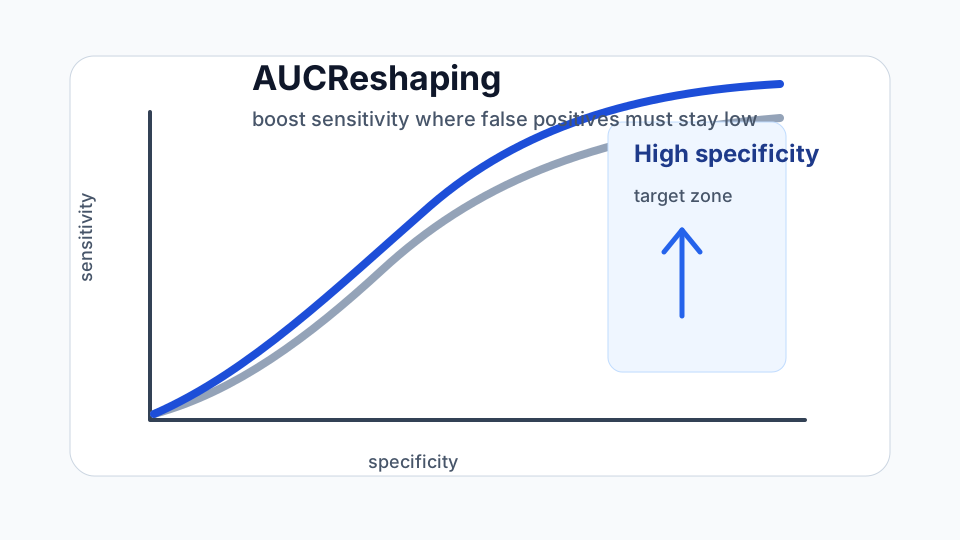
AUCReshaping optimizes classifier behavior near clinically relevant high-specificity operating points rather than treating the full ROC curve uniformly.
Abstract
AUCReshaping is a training strategy for improving sensitivity at clinically important high-specificity operating points.
Why it matters
Many clinical AI systems are deployed under strict false-positive constraints, making operating-point-aware optimization directly relevant.
Contribution
The paper introduces a loss modification that gives extra weight to positive samples misclassified near high-specificity thresholds.
Method overview
During training, the method identifies errors at selected high-specificity decision thresholds, boosts those samples, and backpropagates an augmented cross-entropy loss.
Key findings
- The paper reports sensitivity improvements across multiple test datasets.
- The method is evaluated for chest X-ray and mammography-style classification settings.
- The authors emphasize that optimal boosting depends on the chosen operating point and dataset.
Citation
Bhat S, Mansoor A, Georgescu B, Panambur AB, et al.. (2023). AUCReshaping: Improved Sensitivity at High-Specificity. Scientific Reports.
TODO: Add BibTeX.